Airport hub guide
Quito Mariscal Sucre UIO: the complete layover guide
One terminal on a plateau about 40 km east of the city, three lounges that all take Priority Pass, free wifi, and thin Andean air at 2,400 meters. Here is how to handle a layover at Quito without the guesswork.
Layover verdict Good for connections of almost any length because the single terminal stays open 24 hours, the international lounge never closes, and walks between gates are short. The weak spot is the city itself: central Quito is 45 to 60 minutes away by road, so a city run only makes sense with 7 hours or more.
Best lounge play The Sala VIP Internacional, airside in international departures opposite duty free, runs around the clock, takes Priority Pass, and has showers, nap areas and an open air terrace. Priority Pass has named it a global Airport Lounge of the Year.
The one thing to know The airport sits at roughly 2,400 meters and the city is higher still at about 2,850. If you are connecting from sea level, expect to feel the altitude on stairs and long walks, drink water, and go easy on alcohol.
Last reviewed 28 April 2026
Quick facts
Mariscal Sucre at a glance
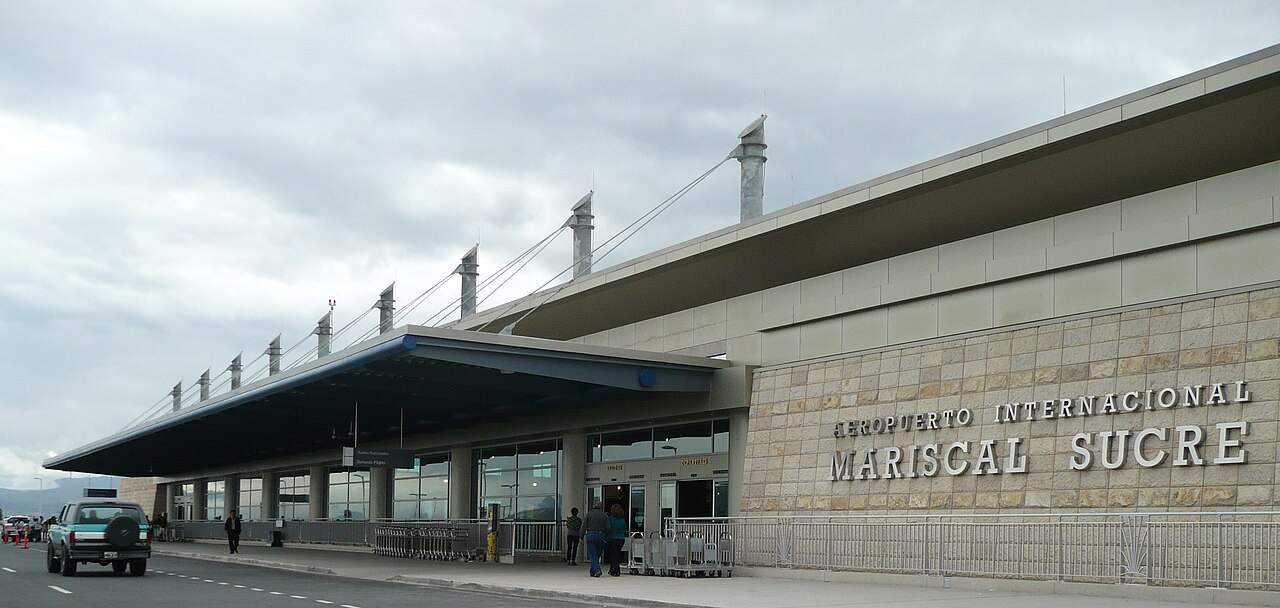
| Terminals | 1, opened in February 2013 on the Tababela plateau east of Quito |
| Airside transit between terminals | Not applicable, every flight uses the single terminal |
| Free wifi | Yes, free wifi on the official airport network throughout the terminal |
| Sleep friendliness | Fair. Terminal open 24 hours, but most seating is metal with fixed armrests; the landside Layover Stay lounge runs around the clock |
| Lounge count | 3: international and domestic VIP lounges airside, Layover Stay landside; all on Priority Pass |
| Nearest in terminal hotel | None inside the terminal; the Wyndham Quito Airport sits about 1 km away with a free 24 hour shuttle |
Orientation
How Mariscal Sucre is laid out
Quito's airport opened in February 2013 on the Tababela plateau, replacing the old airfield that sat hemmed in by the city. The trade was simple: a longer runway and safer approaches in exchange for distance, because the new site lies about 18 km from the city in a straight line and roughly 40 km by road.
The passenger operation is one terminal, and a compact one. Check in spreads across the departures level, then security splits into domestic and international channels. International passengers clear passport control and arrive on the boarding level, where the duty free shop and the Sala VIP Internacional face each other and the gates run along a single concourse. Domestic gates sit in their own section past the domestic checkpoint. Signage runs in Spanish and English, and the walk from check in to the farthest gate rarely takes more than 10 to 15 minutes.
Connections are straightforward by big hub standards. Domestic to domestic on one ticket is relaxed at 60 to 90 minutes. Arriving from abroad and connecting to a domestic flight means immigration, bag claim, customs and a recheck, so treat 2 hours as the floor, and 3 hours on separate tickets. International to international transfers can usually stay airside, though it pays to confirm with your airline because not every itinerary is tagged through.
Landside, the terminal connects to the Quito Airport Center, a commercial building opposite the arrivals doors with restaurants, shops and services that outclass what most South American airports offer outside security. Its second floor holds the Layover Stay lounge, the rare landside lounge that runs 24 hours.
Getting to the city is the part that needs planning. There is no rail link. The official airport taxi cooperative waits outside arrivals around the clock, and the run to La Mariscal or the historic center costs roughly 25 to 35 US dollars in the daytime, more at night, taking 45 to 60 minutes when traffic behaves and longer at rush hour. App based rides operate in Quito as well. The old Aeroservicios express bus between the airport and Parque Bicentenario in the city stopped running, and the current status of any replacement shuttle is to be confirmed; public buses connect the airport with the Rio Coca, Quitumbe and Carcelen terminals for a couple of dollars, but they are slow and awkward with luggage.
Inside the terminal
What the terminal gives you
Landside: check in, the Quito Airport Center and Layover Stay
Check in occupies the departures level and moves quickly outside the late evening international bank, when flights to North America and Europe cluster together. The Quito Airport Center across from arrivals is the landside anchor: restaurants with table service, cafes, a pharmacy and shops, most useful if you are meeting someone or killing time before check in opens. On its second floor, the Layover Stay lounge sells day use rest around the clock, with reclining seats, showers, snacks and wifi, and it accepts Priority Pass. For anyone landing late and flying early without a hotel budget, it is the most comfortable legal place to close your eyes at this airport.
International airside: the lounge that never closes
Past international security and passport control, the boarding level opens onto duty free with the Sala VIP Internacional directly opposite. The lounge, run by airport operator Quiport, is the best single asset at UIO: open 24 hours, with hot food, showers, dedicated sleeping areas, a massage room, private work spaces and an open air terrace looking out at the Andes. Priority Pass opens the door, Diners Club cards issued abroad are accepted, and walk in entry is sold at the desk, with current pricing to be confirmed. Beyond the lounge, the concourse carries cafes, restaurants and shops that thin out overnight between the late departure bank and the early morning arrivals.
Domestic airside
The domestic side gets the Sala VIP Domestica, renovated and roughly doubled in size in 2024 to around 730 square meters with capacity for about 190 passengers. Priority Pass listings show it opening around 4 am and closing around 10 pm, with stays capped at 3 hours. Domestic gate seating is standard armrest fare and fills during the morning waves to Guayaquil and the Galapagos gateways, so a lounge seat is worth claiming early if you hold access.
The overnight reality and the altitude
The terminal stays open 24 hours, landside and airside, and security runs in line with the flight schedule, so nobody gets pushed out at midnight. That does not make the floor friendly: most public seating is metal with fixed armrests, the building cools down at night, and food options shrink to a skeleton crew. If your layover crosses 1 am to 5 am, the realistic ladder is the Layover Stay lounge landside, the Sala VIP Internacional if you are airside with access, or a bed at the Wyndham Quito Airport, about 1 km from the terminal with a free shuttle every half hour around the clock. The altitude is the other overnight factor: at 2,400 meters, travelers arriving from sea level often notice shortness of breath, a mild headache or poor sleep. Move slowly, hydrate, and skip the second glass of wine.
Guides
Quito layover guides
UIO layover guide, hour by hour
What 3, 5 and 8 hours buy you at Quito, the 24 hour lounge, and the honest math on a city run.
UIO lounges
All three Quito lounges with locations, hours and access methods, including the award winning Sala VIP Internacional.
Sleeping at UIO
The 24 hour terminal, the landside lounge, the Wyndham 1 km away and the altitude reality.
Check lounge access for UIO
Three lounges operate at Mariscal Sucre and all of them sell entry to any traveler regardless of airline or cabin. Compare current access options, prices and hours before you fly.
Check lounge accessSome links may earn us a commission at no cost to you.
FAQ
Quito layover questions
Can I sleep overnight at Quito airport?
Yes, the terminal stays open 24 hours and nobody is asked to leave overnight, but most public seating is metal with fixed armrests. The better options are the Layover Stay lounge, open around the clock on the second floor of the Quito Airport Center landside with reclining seats and showers, or a room at the Wyndham Quito Airport, about 1 km away with a free 24 hour shuttle.
Is wifi free at Quito airport?
Yes. The airport provides free wifi on its official network throughout the terminal. Speeds are generally fine for messaging, browsing and calls in the gate areas.
How many lounges does UIO have?
Three. The Sala VIP Internacional sits airside in international departures and runs 24 hours, the Sala VIP Domestica serves the domestic gates from early morning to late evening, and the Layover Stay lounge operates landside around the clock. All three appear in the Priority Pass network.
How far is Quito airport from the city center?
About 18 km in a straight line but roughly 40 km by road, because the airport sits on the Tababela plateau east of the city. Plan on 45 to 60 minutes by taxi in normal traffic and more at rush hour, with daytime fares of roughly 25 to 35 US dollars to central Quito.
Does the altitude affect a layover at Quito airport?
It can. The airport sits at about 2,400 meters and the city is higher still at around 2,850 meters, so travelers arriving from sea level sometimes feel short of breath or develop a mild headache. Take stairs slowly, drink plenty of water, and limit alcohol during your connection.
Nearby
Related airports
Bogota El Dorado (BOG)
The biggest hub in the northern Andes, about 90 minutes by air from Quito and the most common connection point on Avianca itineraries through the region.
Medellin Jose Maria Cordova (MDE)
Colombia's second hub, a frequent low cost connection point for routes between Ecuador, Central America and the United States.
Lima Jorge Chavez (LIM)
The main gateway on South America's Pacific side, around 2 hours by air from Quito, with a new terminal and a much deeper long haul network.
Join Gate Notes
Lounge offers and the layover intel you need at 2am, in your inbox before you fly. Free.
No spam. Unsubscribe any time.